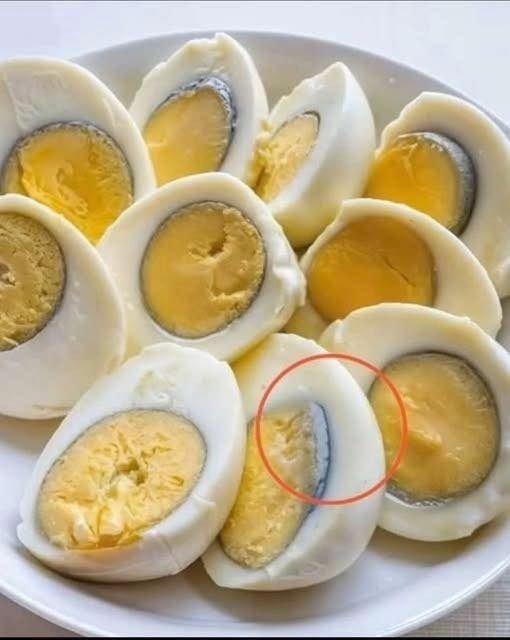
Ah, the classic green ring! This happens a lot with hard-boiled eggs, and it’s actually a chemical reaction, not a sign the egg is bad. Here’s the full explanation:
Why the Green Ring Appears
When you boil eggs, the heat causes the iron in the yolk to react with hydrogen sulfide in the egg white.
Step by step:
- Cooking the egg: Heat makes the egg white proteins release hydrogen sulfide (H₂S).
- Reaction with iron: The yolk contains iron. H₂S reacts with iron → forms ferrous sulfide (FeS).
- Result: A thin greenish-gray layer forms around the yolk where the iron meets the sulfur.
Factors that increase the green ring:
- Overcooking: Longer boiling → more H₂S released → more reaction.
- High heat: Boiling too aggressively speeds up the reaction.
- Older eggs: Whites are more alkaline → release more H₂S.
How to prevent it:
- Don’t overcook: Boil eggs for 9–12 minutes depending on size.
- Cool quickly: Put eggs in an ice bath right after boiling to stop cooking.
- Use slightly fresher eggs: Fresher eggs reduce the intensity of the reaction.
💡 Good to know: The green ring is purely cosmetic—eggs with it are safe to eat, and some people even like the slightly different flavor it gives.
If you want, I can give a foolproof method for perfect, bright yellow yolks with zero green ring every time—it’s surprisingly simple. Do you want me to do that?